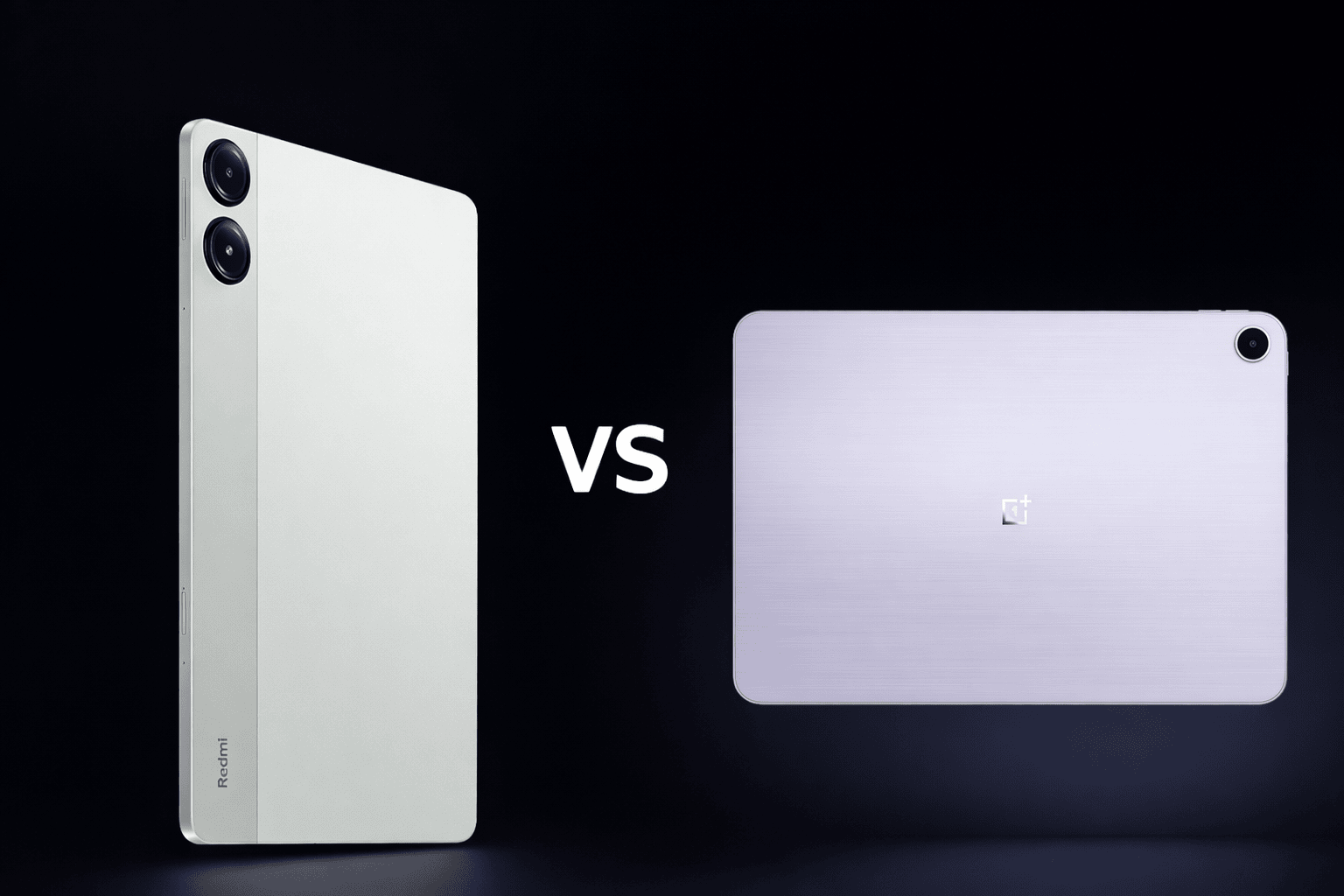
The Redmi Pad 2 Pro has just launched, and it’s entering one of the most competitive tablet price ranges right now — around $300. That’s the sweet spot for students, casual users, and anyone who wants a large screen without spending iPad-level money.
The comparison of the Redmi Pad 2 Pro vs OnePlus Pad Go 2 is essential for potential buyers.
In the Redmi Pad 2 Pro vs OnePlus Pad Go 2 analysis, we explore the differences.
Instead of doing a basic unboxing, I decided to compare it directly with its closest rival, the OnePlus Pad Go 2. It costs roughly $25 more than the Redmi tablet. The big question is simple:
Understanding the Redmi Pad 2 Pro vs OnePlus Pad Go 2 features is crucial for informed decisions.
Join us as we dive into the Redmi Pad 2 Pro vs OnePlus Pad Go 2 showdown.
Is it worth paying extra?
Let’s break it down.
Unboxing Experience of Redmi Pad 2 Pro vs OnePlus Pad Go 2
The Redmi Pad 2 Pro comes in a fairly standard Redmi-style box. Nothing flashy here, just clean and minimal packaging.
Inside the box, you get:
- The tablet wrapped in a protective white sleeve
- A SIM ejector tool
- A USB Type-A to Type-C cable
- A 33W power adapter
It’s a complete package, but there’s one thing worth pointing out.
The included 33W charger feels a bit underwhelming, especially considering the competition. The OnePlus Pad Go 2 offers faster 45W charging, which makes a noticeable difference in real-world usage.
At this price point, many buyers expect faster charging, particularly because the Redmi Pad 2 Pro packs a large battery. A bigger battery combined with slower charging could mean longer top-up times.
I’ll cover actual charging speeds and battery performance in detail later, since that’s going to matter a lot for daily use.
Build & Design Comparison on Redmi Pad 2 Pro vs OnePlus Pad Go 2
| Feature | Redmi Pad 2 Pro | OnePlus Pad Go 2 |
|---|---|---|
| Back Material | Metal | Polycarbonate (Plastic) |
| Frame | Metal | Polycarbonate |
| Finish | Matte | Matte |
| Weight | ~600g | ~600g |
| USB Port | USB 2.0 | USB 2.0 |
| Display Output Support | Not Supported | Not Supported |
| microSD Card Slot | Yes | Yes |
| SIM Support (5G Variant) | Yes | Yes |
| IP Rating | IP53 | No Official Rating |
| Headphone Jack | Yes (3.5mm) | No |
Display Comparison of Redmi Pad 2 Pro vs OnePlus Pad Go 2
| Feature | Redmi Pad 2 Pro | OnePlus Pad Go 2 |
|---|---|---|
| Panel Type | LCD | LCD |
| Screen Protection | Corning Gorilla Glass 3 | Panda Glass 5 |
| Bezels | Slightly thicker | Slimmer, more modern look |
| Aspect Ratio | 16:10 (Better for video) | 7:5 (Better for reading & productivity) |
| Color Performance | Good sRGB coverage | Better Adobe RGB & DCI-P3 coverage |
| Peak Brightness | 466 nits | 860 nits |
| HDR on YouTube | Not Supported | Supported |
| Netflix Dolby Vision | Supported | Supported (Better highlight detail) |
| Display Verdict | Better for 16:9 video viewing & durability | Brighter, more vibrant & stronger multimedia experience |
Both the Redmi Pad 2 Pro and the OnePlus Pad Go 2 use LCD panels. So at a baseline level, you’re not getting OLED-level contrast on either device. But the actual experience is quite different once you look deeper.
The features of the Redmi Pad 2 Pro vs OnePlus Pad Go 2 are compared here.
Protection
- Redmi Pad 2 Pro: Corning Gorilla Glass 3
- OnePlus Pad Go 2: Panda Glass 5
While Panda Glass is decent, Gorilla Glass 3 has a stronger real-world reputation and proven durability. On paper, Redmi has the advantage in screen protection.
Bezels & Screen-to-Body Ratio
The OnePlus Pad Go 2 has slightly slimmer bezels, which gives it a more modern look. The Redmi Pad 2 Pro feels like it has a slightly lower screen-to-body ratio in comparison.
It’s not a huge difference, but side by side, you’ll notice it.
Aspect Ratio: 16:10 vs 7:5
This is one of the biggest differences.
- Redmi Pad 2 Pro: 16:10
- OnePlus Pad Go 2: 7:5
If you mostly watch Netflix or YouTube, 16:10 is better for video content. You get fewer black bars, especially with 16:9 videos.
The 7:5 aspect ratio on the OnePlus tablet gives you more vertical space. That makes it better for:
- Reading
- Web browsing
- PDFs
- Studying
However, when watching 16:9 videos, you’ll notice slightly thicker black bars on the OnePlus device.
So this really depends on how you use your tablet.
Color Performance
In sRGB testing, both tablets are fairly close.
But in Adobe RGB and DCI-P3 colour coverage, the OnePlus Pad Go 2 performs better. You can actually notice this when watching content side by side. Colours look slightly more vibrant on the OnePlus display.
Brightness (Major Difference)
This is where the gap becomes clear.
- Redmi Pad 2 Pro: 466 nits
- OnePlus Pad Go 2: 860 nits
That’s a massive difference.
Higher brightness improves:
- Outdoor visibility
- HDR impact
- Overall punchiness
The OnePlus Pad Go 2 simply looks brighter and more dynamic.
HDR & Streaming
The Redmi Pad 2 Pro does not support HDR playback on YouTube, even though it has Dolby Vision certification for certain apps. That’s confusing and could be due to software optimization.
On Netflix, both tablets support Dolby Vision. However, in side-by-side comparisons, the OnePlus Pad Go 2 maintains better detail in highlights and shadows. You get slightly better dynamic range and more visible detail in complex scenes.
Multimedia Experience
When you combine:
- Higher brightness
- Better color coverage
- Slimmer bezels
The OnePlus Pad Go 2 clearly delivers a stronger multimedia experience. If your priority is streaming, HDR-style content, and overall display quality, OnePlus wins this round.
If you mainly care about watching standard 16:9 videos with fewer black bars and want solid protection, the Redmi Pad 2 Pro still holds its ground.
Display Winner: OnePlus Pad Go 2
Specification of Redmi Pad 2 Pro vs OnePlus Pad Go 2
Technical Specifications Comparison
| Category | Redmi Pad 2 Pro | OnePlus Pad Go 2 |
|---|---|---|
| Processor | Snapdragon 7s Gen 4 | MediaTek Dimensity 7300 Ultra |
| RAM Type | LPDDR4X | LPDDR5X |
| Storage Type | UFS 2.2 | UFS 3.1 |
| Read / Write Speed | Standard (Slower) | Nearly 2× Faster |
| Wi-Fi | Wi-Fi 6 | Wi-Fi 6 |
| Bluetooth | Bluetooth 5.4 | Bluetooth 5.4 |
| Face Unlock | Yes | Yes |
| Gyroscope | Yes | Yes |
Performance & Benchmarks of Redmi Pad 2 Pro vs OnePlus Pad Go 2
Performance & Benchmark Comparison
| Test | Redmi Pad 2 Pro | OnePlus Pad Go 2 | Winner |
|---|---|---|---|
| AnTuTu (Overall) | ~1,000,000 | ~1,000,000 | Very Close (Redmi Slightly Ahead) |
| Geekbench 6 (CPU) | Higher Score | Slightly Lower | Redmi Pad 2 Pro |
| Geekbench 6 (OpenCL – GPU) | Similar | Similar | Tie |
| Geekbench AI | Slightly Higher | Slightly Lower | Redmi Pad 2 Pro |
| 3DMark Wild Life Extreme (Loop Score) | Better Loop Scores | Slightly Lower | Redmi Pad 2 Pro |
| CPU Throttle Test (15–30 mins) | Stable (Green Graph) | Stable (Green Graph) | Tie |
CPU Performance
In both AnTuTu and Geekbench 6 CPU tests, the Redmi Pad 2 Pro performs slightly better. The difference is not massive, but it does show that the Snapdragon chip has a small edge in raw CPU performance.
For everyday tasks like:
- Multitasking
- App switching
- Productivity apps
- Casual gaming
Both tablets will feel smooth.
GPU & Graphics
In the OpenCL GPU benchmark, both tablets perform very similarly. That means for:
- Casual gaming
- Media playback
- UI animations
You’re not going to notice much difference.
AI Performance
In Geekbench AI testing, the Redmi Pad 2 Pro scores slightly higher. This could help with AI-based tasks like:
- Photo processing
- Smart optimizations
- Future AI features in apps
The difference isn’t dramatic, but Redmi has a small advantage here.
Stress Test & Thermal Stability
The 3DMark Wild Life Extreme stress test shows better loop scores on the Redmi tablet. That suggests slightly stronger sustained performance under load.
However, both tablets performed very well in the CPU throttle test. After running 15 to 30 minutes of stress testing:
- The performance graph stayed green
- No major throttling issues
- No serious overheating
Because these are large tablets, they naturally manage heat better than smartphones. Unless you’re using extremely heavy apps for extended periods, throttling shouldn’t be a concern on either device.
Performance Verdict
- Raw CPU & AI Advantage: Redmi Pad 2 Pro
- GPU Performance: Almost Identical
- Thermal Stability: Both Excellent
If you’re focused purely on benchmark numbers, the Redmi Pad 2 Pro wins by a small margin. However, in real-world use, the difference will likely be minimal for most users.
Gaming Test of Redmi Pad 2 Pro vs OnePlus Pad Go 2
Gaming performance is where things get a little more interesting between the Redmi Pad 2 Pro and the OnePlus Pad Go 2.
Neither tablet is built specifically for hardcore gaming, but both are powerful enough for popular titles. The real difference comes down to stability and optimization.
Gyroscope Performance
The gyroscope response on the Redmi Pad 2 Pro feels more consistent and accurate. On the OnePlus Pad Go 2, gyro performance felt slightly inconsistent during testing. It works, but not as reliably. For competitive shooters, that consistency matters.
Gaming Performance Comparison
| Game | Redmi Pad 2 Pro | OnePlus Pad Go 2 | Notes |
|---|---|---|---|
| BGMI | Stable 59–60 FPS | Inconsistent (30 FPS glitch at times) | Redmi more stable |
| Call of Duty Mobile | Stable 60 FPS | Up to 86 FPS | OnePlus higher peak FPS |
| Genshin Impact | ~57 FPS Average | ~48 FPS Average | Redmi smoother |
| Wuthering Waves | 33–34 FPS | 33–34 FPS | Similar performance |
The 30FPS Glitch
During testing on the OnePlus Pad Go 2, there was a recurring issue where some games would suddenly lock to 30FPS. This was first noticed around launch, and it still appears occasionally.
Sometimes the performance improves after restarting or changing settings, but the inconsistency is noticeable. Meanwhile, the Redmi Pad 2 Pro maintained a steady 59–60FPS in most optimised titles.
Real-World Gaming Experience
- If you care about stable performance, Redmi feels more reliable.
- If you care about higher peak FPS numbers, OnePlus shows potential, especially in Call of Duty Mobile.
- In heavy games like Genshin Impact, Redmi performs slightly better on average.
- In demanding titles like Wuthering Waves, both struggle similarly, which is expected for this segment.
Gaming Verdict
Neither tablet is a dedicated gaming device, but both are capable for casual to moderate gaming.
That said:
- More Stable Gaming: Redmi Pad 2 Pro
- Higher Peak FPS Potential: OnePlus Pad Go 2
- Overall Gaming Edge: Slightly in favor of Redmi
Actual performance may vary depending on game updates, software optimization, and future patches.
OS & UI Experience of Redmi Pad 2 Pro vs OnePlus Pad Go 2
| Category | Redmi Pad 2 Pro | OnePlus Pad Go 2 |
|---|---|---|
| Android Version | Android 15 | Android 16 |
| Major Updates | 5 Years (Effectively 4 Remaining) | 5 Years |
| Security Updates | 7 Years | 6 Years |
| UI Experience | HyperOS – Smooth but slightly slower animations, more neutral design | OxygenOS – Smoother animations, refined transitions, cleaner typography |
| App Performance | Smooth app opening & closing | Smooth app opening & closing |
| Bloatware | Minimal | Minimal |
| Floating Windows | Supports 2 at once | Supports 1 at a time |
| Split Screen | Supported | Supported |
| PC Mode | Not Available | Not Available |
| Stylus Support | Yes (Sold Separately, ~ $50) | Yes (Sold Separately, ~ $50) |
| Keyboard Features | Extra native keyboard settings & key mapping | Standard keyboard support |
| AI Features | Basic AI tools, Circle-to-search, AI editor inconsistent | AI Writer, Translate, Voice Scribe, AI Editor, AI Speak |
| Overall Software Verdict | Better security support & multitasking flexibility | Better animations, AI tools & overall UI polish |
OS & UI Verdict of Redmi Pad 2 Pro vs OnePlus Pad Go 2
- Better Animations & Visual Polish: OnePlus Pad Go 2
- More Refined AI Features: OnePlus Pad Go 2
- Longer Security Support: Redmi Pad 2 Pro
- Better Floating Window Multitasking: Redmi Pad 2 Pro
Overall, in terms of software experience and UI polish, OnePlus Pad Go 2 is the winner.
Battery and charging of Redmi Pad 2 Pro vs OnePlus Pad Go 2
| Category | Redmi Pad 2 Pro | OnePlus Pad Go 2 |
|---|---|---|
| Battery Capacity | 12,000mAh | 10,500mAh |
| Charging Speed | 33W Fast Charging | 45W Fast Charging |
| Full Charge Time | Approx. 3 Hours | Approx. 2 Hours |
| Reverse Charging | Yes (Brand Claim: 27W, Tested: 8–9W) | Not Supported |
| Continuous Screen-On Time | 12–13 Hours (YouTube, multimedia, speakers active) | 8–10 Hours (YouTube, multimedia, speakers active) |
| Typical Usage Backup | 1–2 Days (Mixed usage) | 1–2 Days (Mixed usage) |
| Battery Verdict | Better battery backup & emergency reverse charging support | Faster charging speed |
cameras test of Redmi Pad 2 Pro vs OnePlus Pad Go 2
| Category | Redmi Pad 2 Pro | OnePlus Pad Go 2 |
|---|---|---|
| Rear Camera | 8MP (13MP on 5G Variant) | 8MP |
| Front Camera | 8MP | 8MP |
| Flash | Yes (Useful for document scanning) | No Flash |
| Photo Quality | Basic tablet-level photos (Indoor & Outdoor) | Basic tablet-level photos (Indoor & Outdoor) |
| Video Recording | 1080P at 30FPS (Front & Rear) | 1080P at 30FPS (Front & Rear) |
| Video Stability | Decent for walking shots & video calls | Decent for walking shots & video calls |
| Microphone Quality | Clear enough for video calls | Clear enough for video calls |
| Camera Verdict | Advantage: Flash + 13MP option (5G variant) | Similar overall performance |
Redmi Pad 2 Pro vs OnePlus Pad Go 2 – Pricing (US)
| Model & Variant | Connectivity | Price (Approx. USD) | Buy |
|---|---|---|---|
| Redmi Pad 2 Pro (8GB / 128GB) | Wi-Fi | $300 | Check Price |
| OnePlus Pad Go 2 (8GB / 128GB) | Wi-Fi | $325 | Check Price |
| Redmi Pad 2 Pro (8GB / 128GB) | 5G | $335 | Check Price |
| OnePlus Pad Go 2 (8GB / 128GB) | 5G | $390 | Check Price |
Conclusion of Redmi Pad 2 Pro vs OnePlus Pad Go 2
If your budget is around $300, the Redmi Pad 2 Pro is a very solid pick. You’re getting a large 12,000mAh battery, dependable performance, a premium metal build, IP53 splash resistance, and even a headphone jack, which is becoming rare. Battery life is one of its biggest strengths. That said, it does have a few trade-offs. The display isn’t as bright, there’s no HDR support on YouTube, it uses older LPDDR4X RAM and UFS 2.2 storage, and the overall software experience isn’t as polished.
If you’re willing to spend about $25 more, the OnePlus Pad Go 2 offers some meaningful upgrades. The software feels smoother and more refined, you get faster 45W charging, HDR support, LPDDR5X RAM, and faster UFS 3.1 storage. The display is brighter, and the speakers deliver a better overall audio experience. On the downside, there’s no official IP rating, the gyro performance isn’t the most accurate, and it doesn’t include a rear flash like the Redmi.
Both tablets are strong options in this price range. If I had to choose, I’d lean toward the OnePlus Pad Go 2 for the better display quality, stronger speakers, and more polished user interface.
Ultimately, it comes down to priorities. If you want maximum battery life and durability for the price, go with Redmi. If you value smoother software, a brighter display, and faster performance, the OnePlus is worth the small price jump.