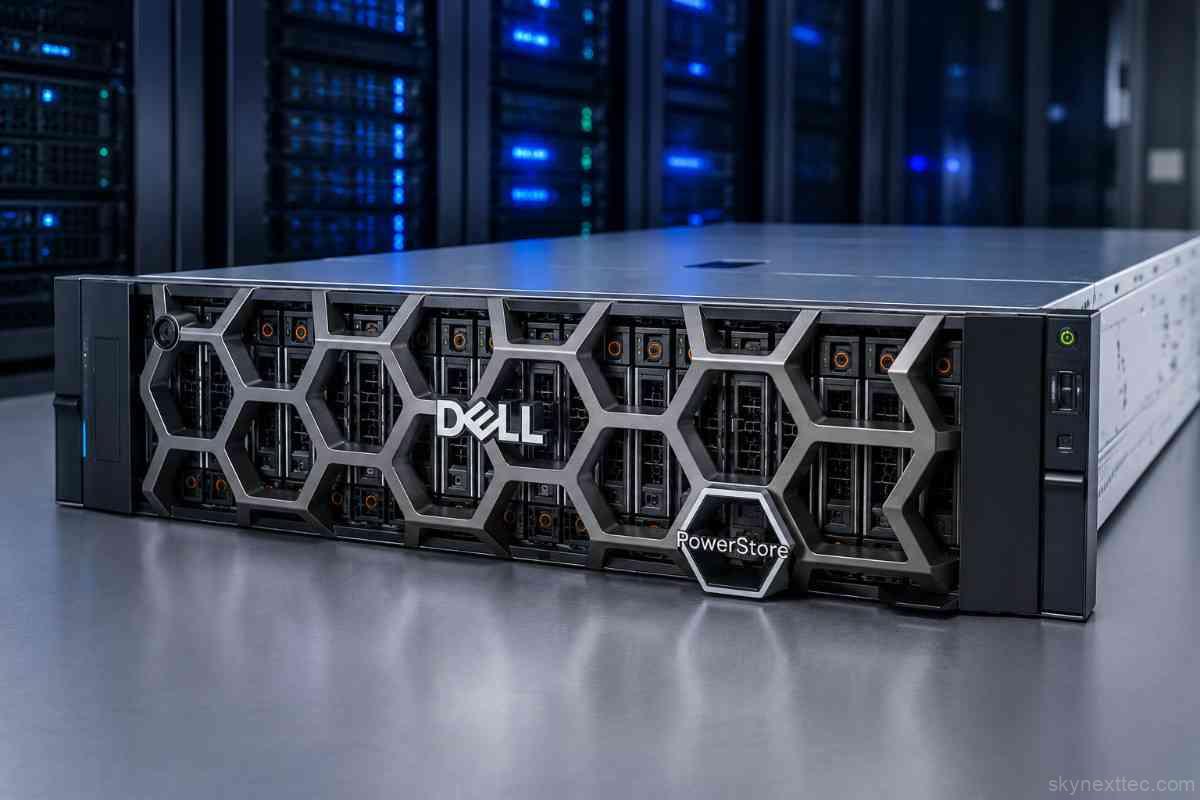
The Dell PowerStore Gen 3 is a cutting-edge storage solution that offers unparalleled performance, scalability, and flexibility. With its advanced architecture and intelligent automation, it delivers exceptional data management capabilities, empowering businesses to optimise their storage infrastructure and drive digital transformation.
The new architecture moves beyond simple hardware refreshes. Dell has redesigned the platform from the ground up to better support modern enterprise workloads, AI infrastructure, virtualization, and high-density flash storage environments.
Massive Hardware Redesign
One of the first changes users will notice is the move from a 2U chassis to a larger 3U design. While the system occupies slightly more rack space, the additional room allows Dell to dramatically increase storage density and thermal efficiency.
The standout feature is support for up to 40 NVMe SSDs in a single chassis using modern E3.S storage drives, while also supporting larger E3.L drives for future expansion. This gives businesses far more flexibility when scaling performance or capacity.
Dell claims the new design allows customers to use industry-standard SSDs rather than relying on proprietary hardware, helping reduce long-term upgrade complexity.
Three Models for Different Enterprise Needs
The PowerStore Gen 3 family includes three main models:
- PowerStore 1500
- PowerStore 5500
- PowerStore 9500
The entry-level 1500 already delivers more than double the performance of some previous-generation systems, according to Dell engineers.
The higher-end 5500 and 9500 models introduce dual Intel CPU configurations, larger DDR5 memory capacities, and significantly more PCIe bandwidth for demanding enterprise workloads.
Transition to Full NVMe Architecture
Dell has fully transitioned the platform to NVMe storage, replacing older SAS-based designs used in previous generations.
This change improves:
- Latency
- Throughput
- Data access speeds
- Storage efficiency
- Overall system responsiveness
The system also removes dedicated NVRAM drives previously used for data protection. Instead, Dell now uses a software-defined persistent memory architecture combined with battery-backed cache protection.
This redesign frees additional front storage bays for customer workloads while simplifying the hardware layout.
Improved Cooling and Serviceability
Cooling was clearly a major focus during development.
The larger 3U chassis allows for:
- Larger heat-sinks
- Better airflow
- Modular fan systems
- Improved thermal management
- Easier maintenance access
Dell also redesigned the controller layout to improve serviceability. Previous Dell PowerStore Gen 3 systems used inverted controller orientations, which occasionally confused maintenance. The new layout keeps both controllers aligned in the same orientation, reducing operational risks during servicing.
Most components, including fans, batteries, M.2 boot drives, and memory modules, can now be replaced without tools.
DDR5 Memory and Intel CPUs
The Dell PowerStore Gen 3 lineup adopts the latest Intel processors alongside DDR5 memory technology.
Configuration highlights include:
The flagship 9500 model reportedly uses dual 32-core Intel CPUs, delivering major performance gains for enterprise virtualization and AI-heavy workloads.
More PCIe Gen 5 Connectivity
Dell has significantly expanded PCIe capabilities in Gen 3.
Previous PowerStore systems offered limited proprietary I/O modules. The new generation introduces:
- Standard OCP 3.0 slots
- PCIe Gen 5 support
- 64Gb Fibre Channel support
- 100Gb networking options
- More front-end connectivity
This shift toward industry-standard components should simplify upgrades and future compatibility.
The platform also introduces RDMA inter-node communication modules located at the front of the chassis. Higher-end models support up to 200Gb RDMA connectivity between controllers.
Better Scalability for Future Storage Growth
One of the most important long-term advantages of Dell PowerStore Gen 3 is expandability.
Dell designed the chassis to support future high-capacity E3.L SSDs, potentially allowing extremely large storage deployments inside a compact footprint.
In theory, future configurations could approach multi-petabyte capacities within a single enclosure using next-generation high-density flash drives.
PowerStore OS 5.0
The new hardware launches alongside PowerStore OS 5.0.
The updated operating system introduces improvements, including:
- Dynamic resource balancing
- Enhanced data reduction
- Unified NAS and block storage support
- Better performance optimization
- Expanded security features
Dell also integrates iDRAC-style management capabilities into the storage platform, replacing older proprietary management systems.
Enterprise Storage Strategy Shift
Dell PowerStore Gen 3 is more than a routine refresh. It signals a broader strategy shift from Dell toward modular, standards-based enterprise infrastructure.
Key improvements include:
- Full NVMe architecture
- Standardized OCP networking
- Tool-less servicing
- Better cooling
- Increased flash density
- Simplified scalability
- Improved efficiency
For enterprise customers planning long-term infrastructure investments, these changes could significantly reduce operational complexity while improving performance and future upgrade flexibility.
Final Thoughts
The new Dell PowerStore Gen 3 platform appears to be one of Dell’s most ambitious storage releases in years.
With support for 40 NVMe SSDs, PCIe Gen 5, DDR5 memory, high-speed RDMA connectivity, and modern Intel processors, the platform is clearly built for next-generation enterprise workloads.
Dell’s decision to adopt more industry-standard components also makes the system more serviceable and easier to evolve over time.
For businesses focused on virtualisation, AI infrastructure, private cloud environments, or high-performance enterprise storage, Dell PowerStore Gen 3 could become one of the most compelling storage platforms entering the market this year.
Storage Review: Dell PowerStore Gen 3 Deep Dive