If you’re planning to buy a high-end gaming laptop in 2026 and are considering the RTX 5070 vs RTX 5070 Ti, this comparison will help you decide more easily.
At first glance, both GPUs look quite similar, but there are some important differences in terms of performance and value for money. The biggest difference is VRAM. The RTX 5070 comes with 8GB, while the RTX 5070 Ti offers 12GB. This can make a real difference in demanding games and creative workloads.
However, prices are not fixed. They vary based on other specifications such as the processor, RAM, storage, display, and battery life. Because of this, each laptop offers a slightly different balance of performance and value.
In this article, we’ll break down the real-world performance differences between the RTX 5070 and RTX 5070 Ti, and help you decide whether the extra cost is actually worth it.
RTX 5070 vs 5070 Ti Specification
| Spec | RTX 5070 | RTX 5070 Ti |
|---|---|---|
| Laptops | Legion Pro 5i | Legion 7 |
| CPU | Intel Core Ultra 9 275HX | |
| RAM | 32GB DDR5 (6400 MT/s) | |
| VRAM | 8GB | 12GB |
| TGP | 115W | 140W |
| Perf. Gain | Base | ~28% faster |
| AI Perf. | – | ~24% better |
Before getting into the results, it’s important to understand the testing setup. Both laptops used in this comparison are different models: the Lenovo Legion 7 and the Lenovo Legion Pro 5i. These were chosen because finding two identical high-end configurations is difficult, but the goal was to keep the comparison as fair as possible.
Both laptops come with the same core hardware, including the Intel Core Ultra 9 275HX processor and 32GB of DDR5 RAM running at 6400 MT/s. This ensures that the performance differences you see are mainly due to the GPU and not other components.
On the GPU side, the RTX 5070 Ti shows around a 28% performance improvement over the RTX 5070 across CUDA, RT, and Tensor workloads. It also comes with 4GB more VRAM (12GB vs 8GB), which makes it more suitable for demanding games and creative workloads.
| Spec | RTX 5070 | RTX 5070 Ti | Gain |
|---|---|---|---|
| CUDA | 4608 | 5888 | +28% |
| RT Cores | 36 | 46 | +28% |
| Tensor | 144 | 184 | +28% |
| VRAM | 8GB | 12GB | +50% |
| Bandwidth | 384 GB/s | 672 GB/s | +75% |
| AI TOPS | 798 | 992 | +24% |
| TGP | 115W | 140W | +22% |
There is also a difference in power limits. The RTX 5070 runs at up to 115W, while the RTX 5070 Ti can go up to 140W, allowing it to maintain higher performance under sustained load. In addition, the 5070 Ti benefits from higher memory bandwidth, which improves how quickly it accesses VRAM data.
Overall, these technical improvements translate into around 24% better AI performance on the RTX 5070 Ti compared to the RTX 5070.
RTX 5070 vs 5070 Ti Performance & Benchmarks
To understand the real difference between these two GPUs, we tested them across multiple synthetic and real-world benchmarks.
3DMark & VR Performance
3DMark TimeSPY Graphic Score
Starting with 3DMark Time Spy, the RTX 5070 Ti shows around a 20% higher graphics score compared to the RTX 5070, which clearly highlights its stronger raw gaming performance. In VRMark, however, the difference is minimal. The RTX 5070 scores around 17,000 while the 5070 Ti reaches roughly 18,000, meaning both GPUs are capable of handling VR gaming at a good level.
Rendering & Creative Performance
Moving to creative workloads, the Blender Benchmark shows an average improvement of around 18%, with certain rendering tasks like the BMW scene showing up to a 28% faster render time. In real terms, that’s a drop from around 16 seconds on the RTX 5070 to about 12 seconds on the 5070 Ti, which becomes more noticeable in larger projects.
Productivity Performance (Adobe Suite)
For productivity tasks, we ran the PugetBench suite. In Adobe Premiere Pro, both GPUs perform similarly in general editing, but the RTX 5070 Ti has an advantage during export due to higher VRAM. In After Effects, the difference is small at around 4–5%, and in Photoshop, the GPU impact is minimal since it is mostly CPU-dependent.
Synthetic & AI Benchmarks
In Geekbench 6 OpenCL, the performance gap sits at around 18%, while AI-focused tests show a smaller difference of about 11–12%, depending on precision mode and workload type.
AI Text Generation Benchmark
Higher Scores = Better Performance
DeepSeekR1 32B Benchmark
LM Studio | Calculated in Seconds | Lower is Better
AI workloads are where both GPUs are increasingly being used. In Geekbench AI, the RTX 5070 Ti shows around 11–12% better performance. However, real-world testing with a DeepSeek R1 32B model showed only a minor difference of about 4%, with both GPUs completing tasks in roughly the same time. This shows that performance can vary depending on the model size and type of prompt used.
Image Generation & Computer Vision
AI Computer Vision Benchmark
Tensor RT | Higher Scores = Better Performance
In image generation workloads, the RTX 5070 Ti performs noticeably better, delivering around 20–30% faster output times, while computer vision tasks show only a small difference between the two GPUs.
Overall Performance Summary
Overall, when all workloads are combined, the RTX 5070 Ti delivers an average performance gain of around 20–25%, which is significant for professional users. However, whether this upgrade is worth the extra cost depends entirely on your workload. For gaming and general use, the difference is smaller, but for productivity, AI, and rendering tasks, the 5070 Ti clearly provides better long-term value.
RTX 5070 vs 5070 Ti Gaming Performance Test
Now let’s talk about real gaming performance and how both GPUs actually behave in modern titles. All games were tested at 1600P (native resolution for most gaming laptops) and 4K settings to understand both practical and high-end performance differences.
Cyberpunk 2077
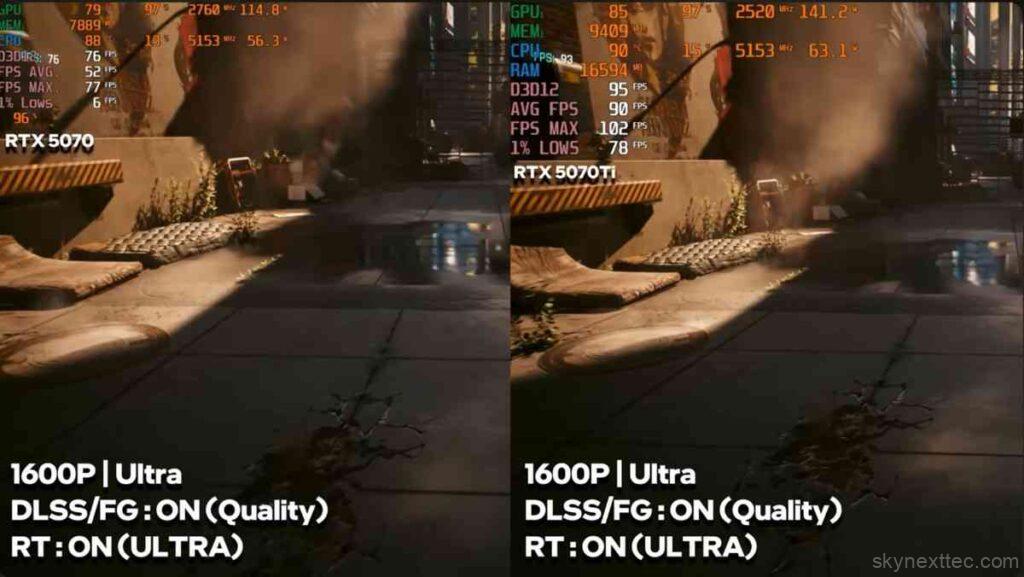
In Cyberpunk 2077 on ultra settings, the RTX 5070 Ti delivers around 10–15 FPS higher performance compared to the RTX 5070 in raw gameplay. When frame generation is enabled, both GPUs see a similar uplift of around 15–20 FPS, but the 5070 Ti maintains a more stable experience due to higher base frame rates. In ray tracing scenarios, the 5070 Ti clearly performs better, thanks to more RT cores, although the improvement is not massive. The key advantage again comes from higher base FPS, which improves frame generation efficiency.
Black Myth: Wukong
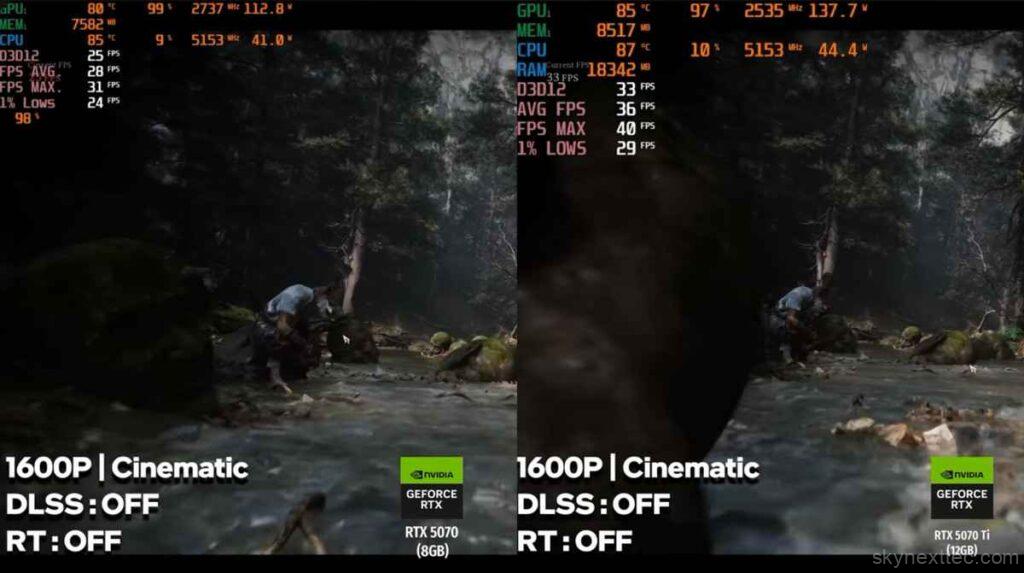
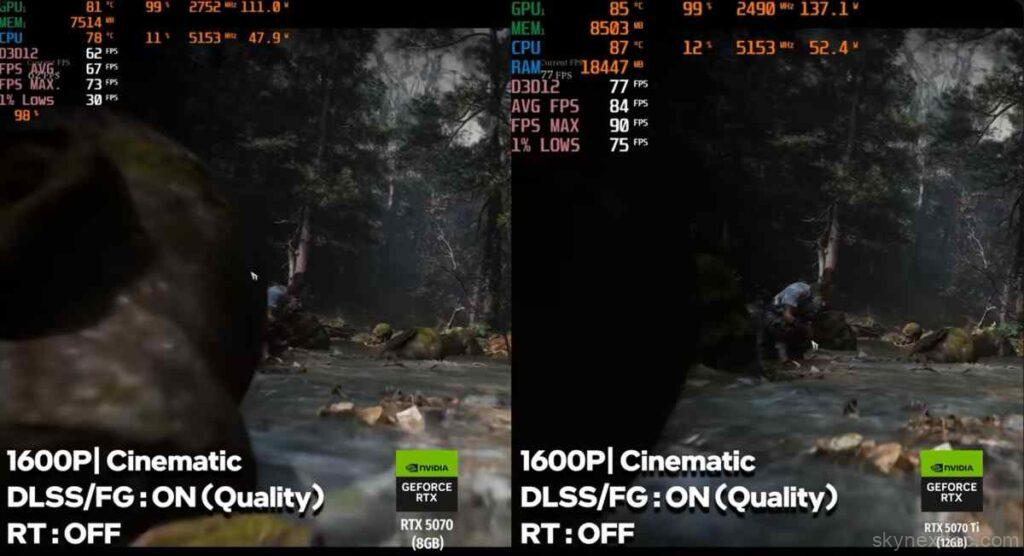
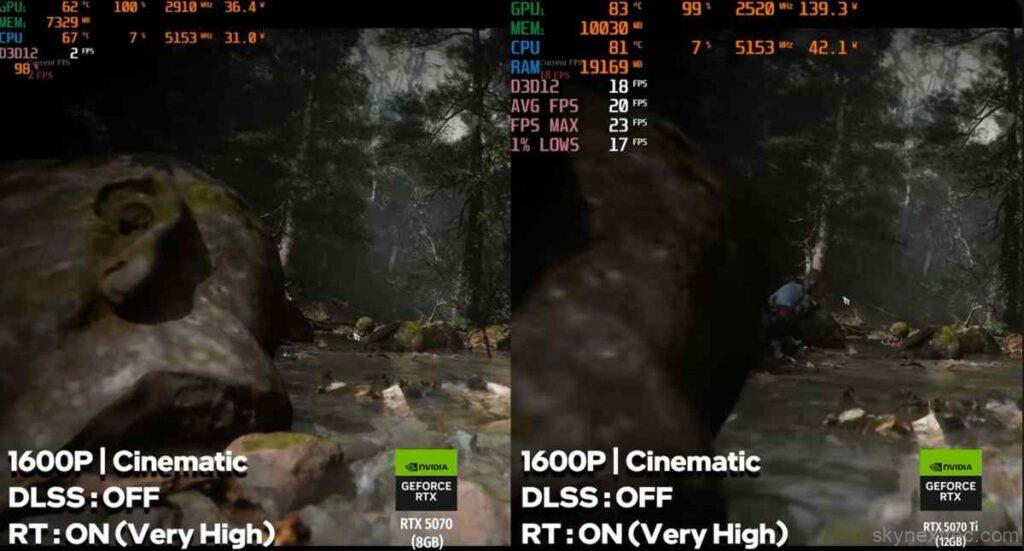
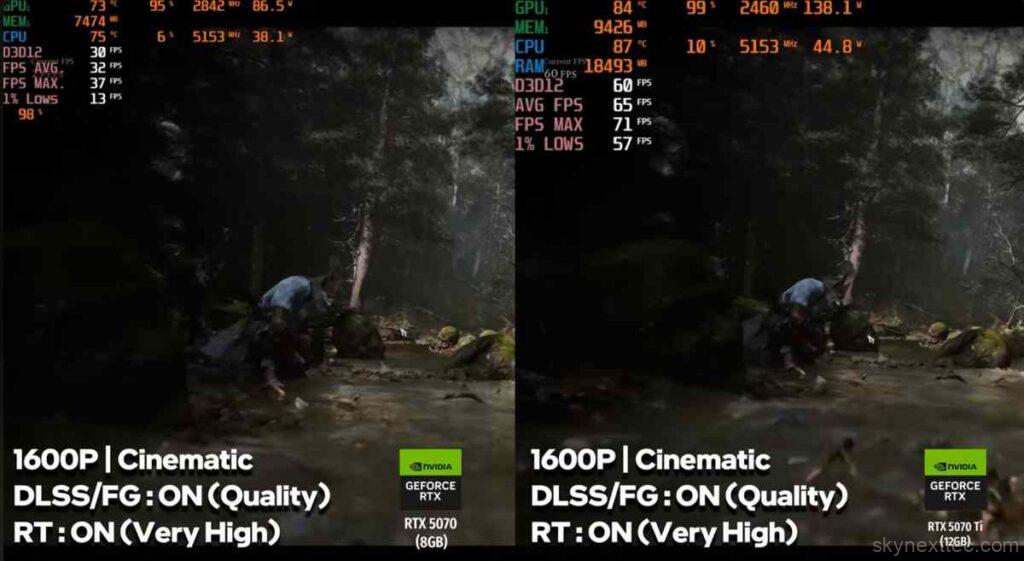
In Black Myth: Wukong on cinematic settings, the difference in raw performance is around 5 FPS, but things change when ray tracing is enabled. At very high settings, the RTX 5070 struggles with low base frame rates, while the 5070 Ti remains more playable, although still demanding. Frame generation improves performance significantly, but the experience depends heavily on stable base FPS. The 5070 Ti consistently benefits more due to its stronger baseline performance.
Alan Wake 2
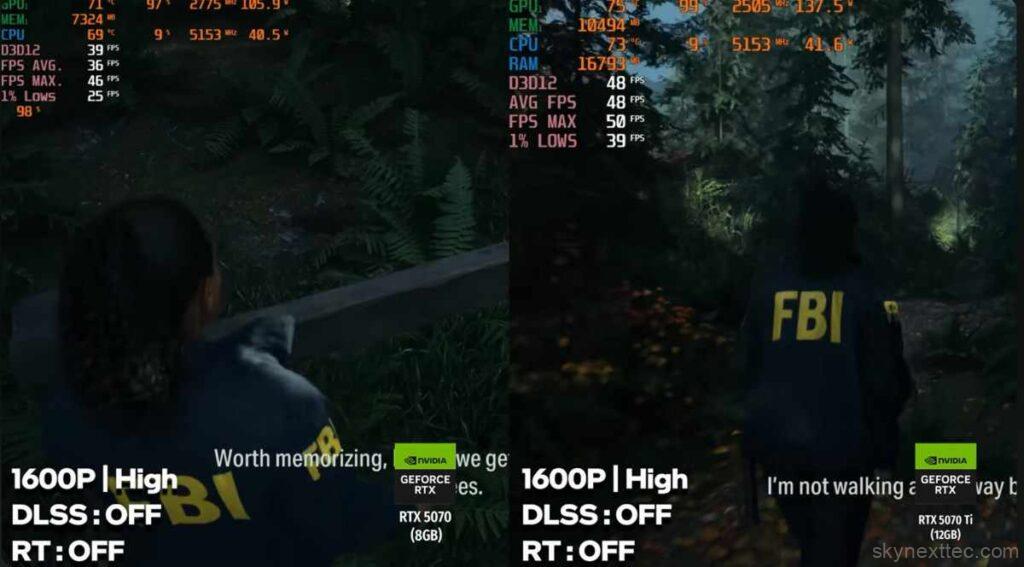
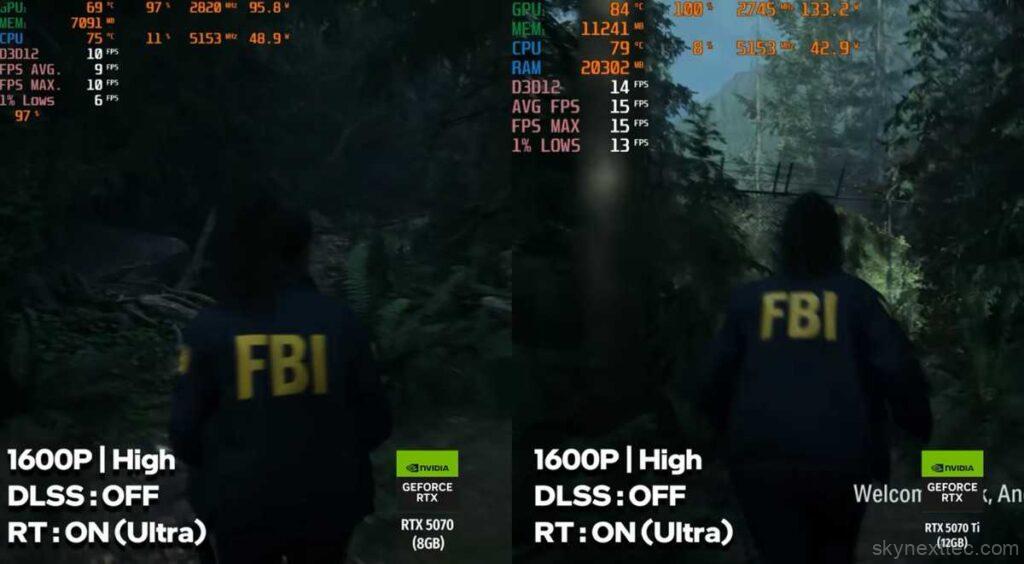
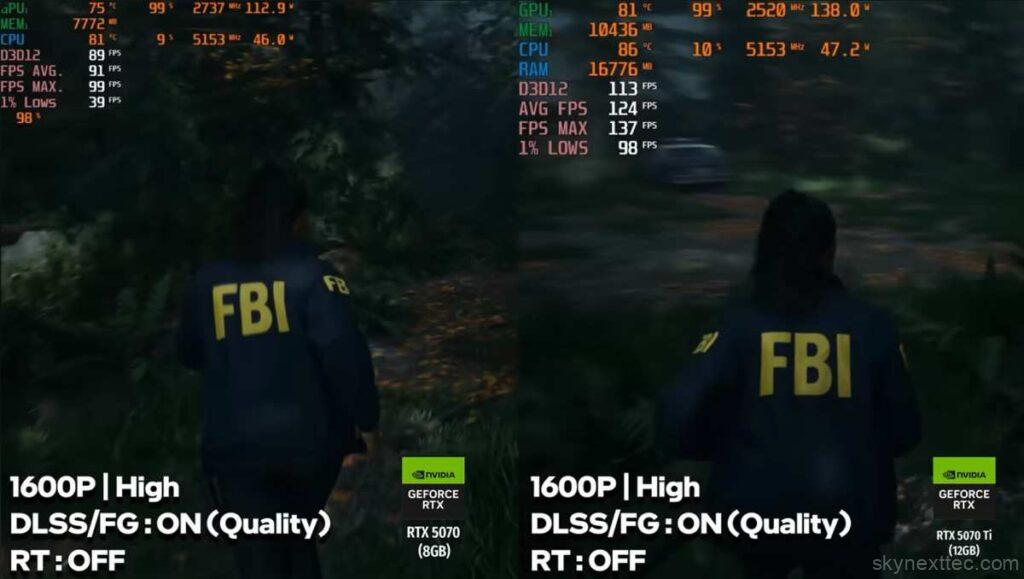
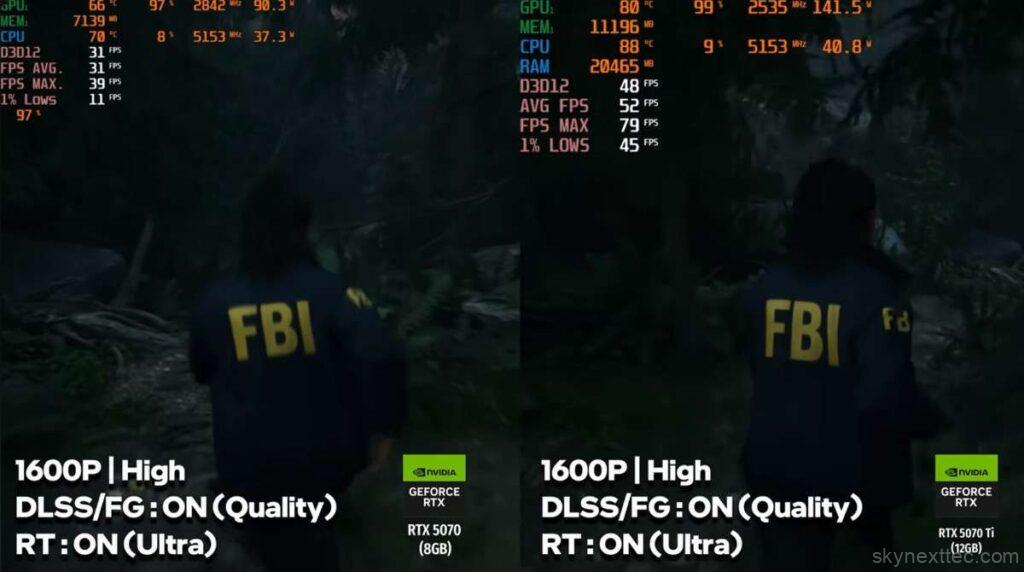
Alan Wake 2 shows a similar pattern. In raw performance at 1600P, the RTX 5070 Ti delivers noticeably smoother gameplay. Once frame generation is enabled, both GPUs can reach smooth frame rates, often crossing 60 FPS. However, the 5070 Ti again maintains better consistency, especially in heavier scenes with ray tracing enabled.
Assassin’s Creed Shadows
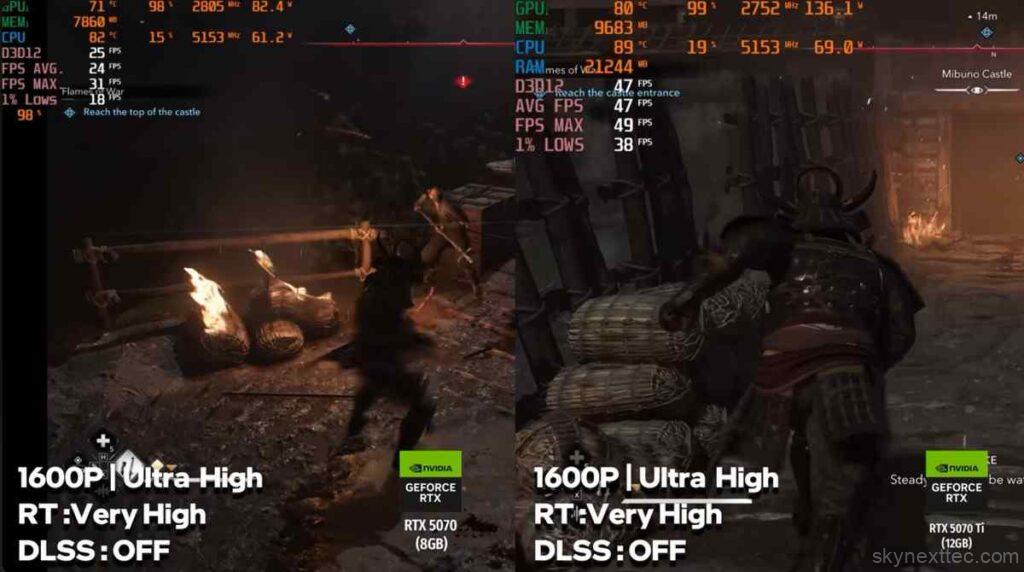
This title highlights a more visible gap. At ultra settings with high ray tracing, the RTX 5070 Ti offers a playable experience, while the RTX 5070 struggles with noticeable stutters and lower stability. The difference here is not just FPS but overall smoothness, making the 5070 Ti a better option for demanding open-world titles.
The Last of Us Part II
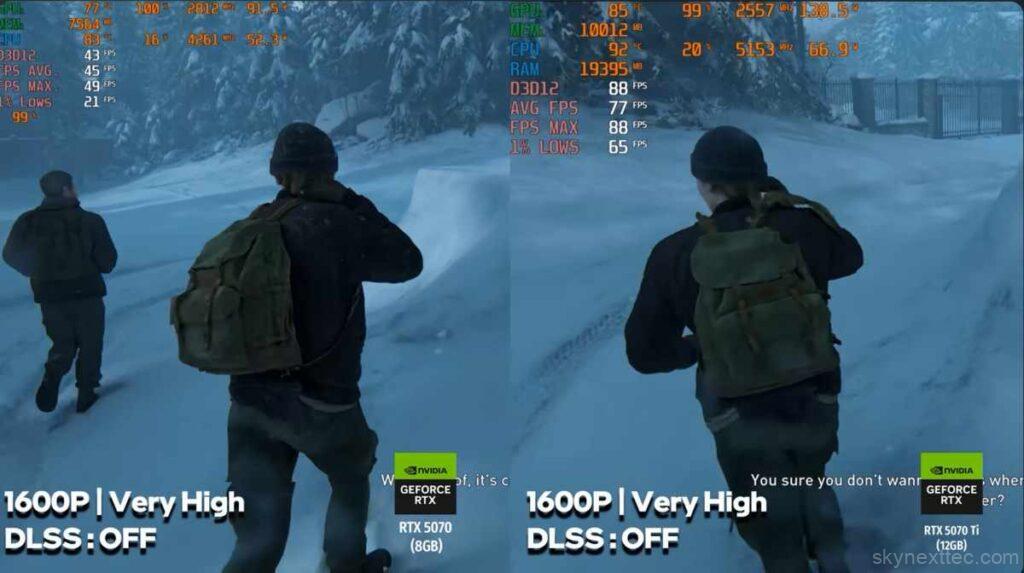
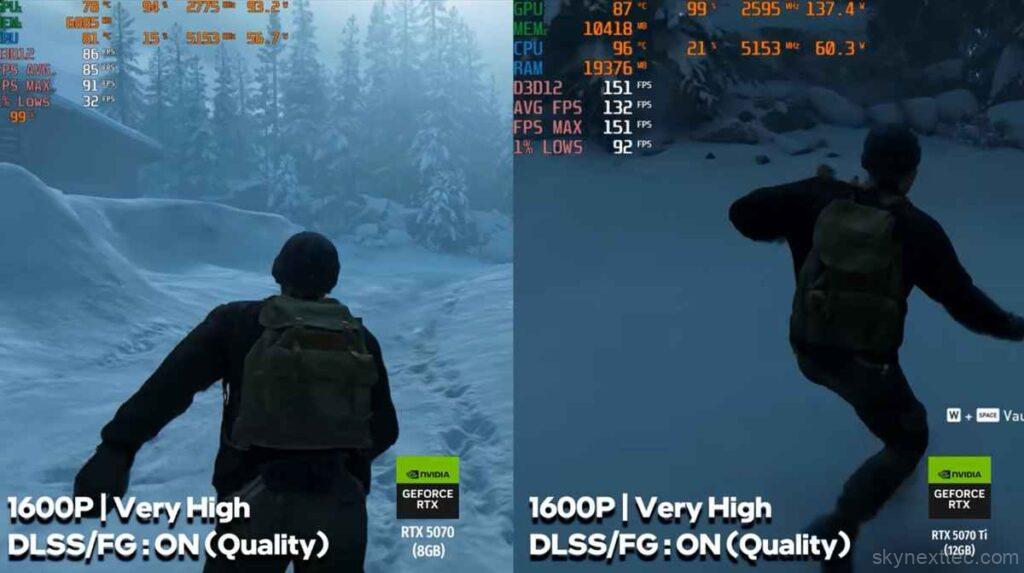
In The Last of Us Part II, the RTX 5070 delivers around 40–60 FPS, while the RTX 5070 Ti reaches 80–90 FPS in the same settings. With DLSS frame generation enabled, both improve significantly, but the 5070 Ti still maintains a clear lead of around 20–30 FPS, especially in heavier scenes.
Senua’s Saga: Hellblade II
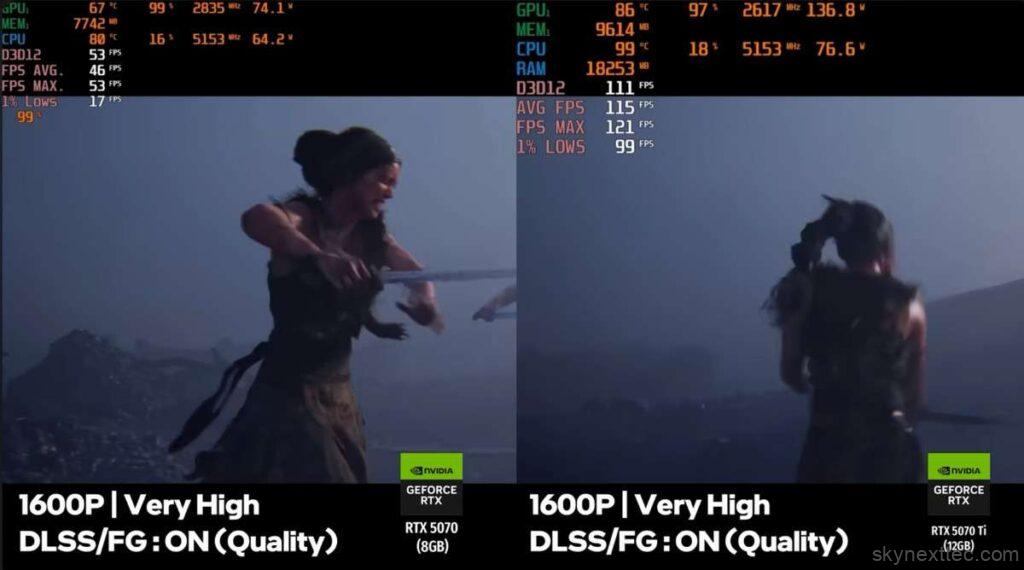
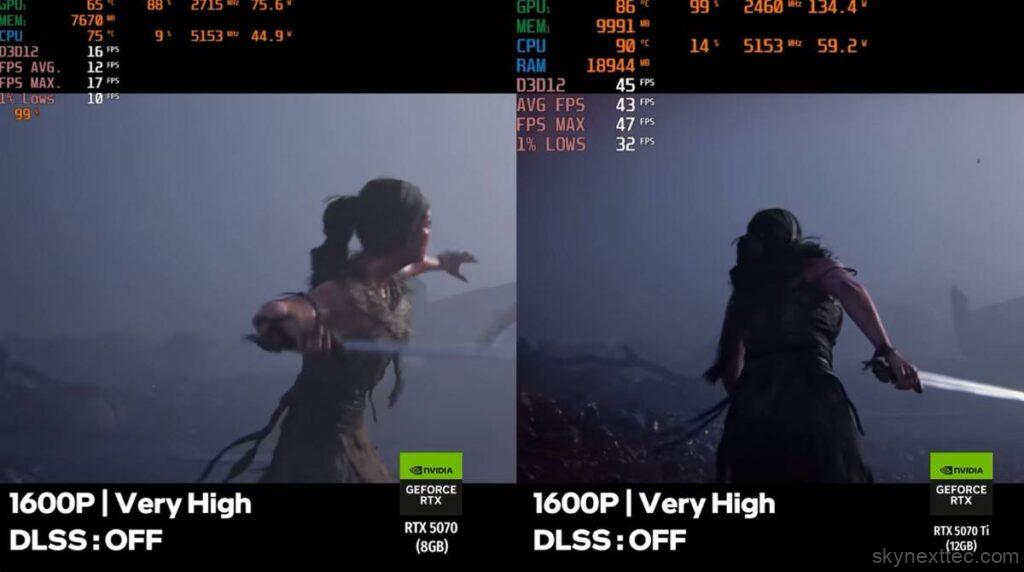
Hellblade II is extremely demanding. On raw performance, the RTX 5070 Ti sits around 30–40 FPS, while the RTX 5070 struggles further. With frame generation enabled, the 5070 Ti can reach up to 100 FPS equivalent smoothness, but this depends heavily on stable base frames. The RTX 5070 shows more inconsistency and lower overall fluidity.
4K Gaming Performance
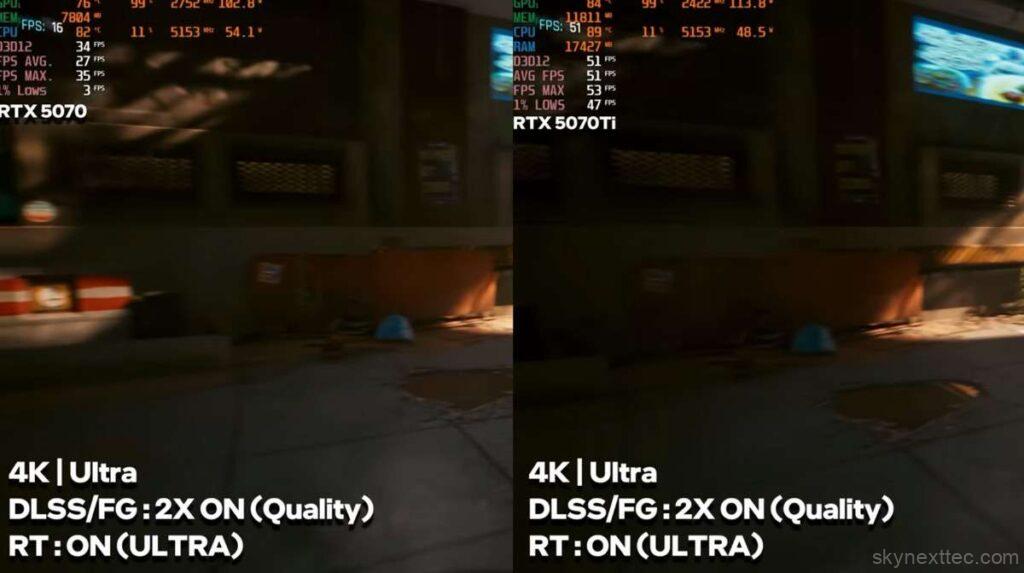
At 4K resolution, Cyberpunk 2077 was used as the main test case. As expected, the GPU with higher VRAM performs better, and the RTX 5070 Ti holds a clear advantage in both raw performance and frame generation stability.
In ray tracing ultra settings, the 5070 Ti benefits from higher base frames, which directly improves DLSS frame generation output. Even with multi-frame generation enabled, performance scaling remains better on the 5070 Ti, typically delivering around 20–30% higher FPS overall.
However, in very demanding titles like Black Myth: Wukong and Hellblade II at 4K, both GPUs struggle in native performance. Frame generation helps improve playability, but only when base frame rates are stable enough. The RTX 5070 Ti remains more consistent, while the RTX 5070 often falls behind in smoothness and stability.
Overall Gaming Conclusion
Across all tested games, the RTX 5070 Ti consistently delivers around 20–30% better gaming performance, especially in demanding titles and ray tracing scenarios. The biggest advantage is not just higher FPS, but more stable base frame rates, which directly improves the effectiveness of frame generation.
For 1600P gaming, both GPUs are usable, but for higher settings, ray tracing, and future AAA titles, the RTX 5070 Ti clearly offers a more reliable and smoother experience.
RTX 5070 vs 5070 Ti Conclusion
| Feature | 5070 | 5070 Ti |
|---|---|---|
| Gaming | 1080p / 1440p | +20–30% faster |
| VRAM | 8GB | 12GB |
| Ray Tracing | Medium | High / Ultra |
| Frame Gen | Good | More stable |
| AI / Prod | Base | +20–25% |
| Power | 115W | 140W |
| Value | Budget | Premium |
To sum it up, the RTX 5070 Ti delivers around a 20–30% performance boost over the RTX 5070 in gaming, especially at higher resolutions and demanding settings. If you’re aiming for a more future-proof gaming laptop, the 5070 Ti is clearly the stronger option thanks to its higher VRAM and better overall performance headroom.
However, the decision ultimately depends on your budget. The RTX 5070 is still a very capable GPU and handles 1080p, 1440p, and even 1600p gaming quite well with the right settings. In many cases, you can simply adjust resolution or graphics settings and still get a smooth experience without needing to spend extra.
The RTX 5070 Ti makes more sense if you want higher stability in modern AAA titles, better ray tracing performance, and longer-term usability. But if your focus is value for money, the RTX 5070 sits in a very strong sweet spot.
For users considering spending above the mid-range price bracket, it’s also worth noting that GPUs like the RTX 5060-class can already handle most modern games at high settings. Higher-end options become more relevant mainly for users who are into AI workloads, video editing, 3D rendering, or professional content creation.
In the end, pricing varies depending on the brand, configuration, CPU, RAM, and storage, so it’s always worth comparing models before making a final decision.